Lahore, 10 August 2026 Farming in Pakistan is getting harder. Heat arrives earlier, rainfall is increasingly unpredictable, groundwater tables are falling, and pests and diseases are spreading under changing climatic conditions.
The Climate Smart Village Initiative (CSVI), a joint initiative of Bank Alfalah and SAWiE Ecosystems, is designed to respond to these challenges at the level where farmers actually make decisions at the village. The initiative brings together climate smart agricultural practices, digital advisory, soil and water diagnostics, farmer training, monitoring and access to finance, with the aim of making sustainability both practical and economically viable for farmers.
On 10 August 2026, SAWiE Ecosystems and Bank Alfalah hosted a Climate Smart Village Showcase and Roadshow in Lahore, bringing together farmers, researchers, agricultural experts, policymakers, financial institutions, technology providers, supply chain representatives and sustainability professionals. Around 75 participants attended the event in person, representing different parts of Pakistan agricultural ecosystem including farmers, agri input suppliers, processors, research organisations, universities and civil society organisations.
A Village Level Approach to Climate Resilience
Rather than promoting one technology package across the country, CSVI starts with a baseline assessment of each village, including soil testing and discussions with farmers to understand local priorities.
Farmers then work with the programme team to identify what needs to change, with support provided through climate smart advisory, digital monitoring, demonstrations, training and access to finance.
The programme is organised around six interconnected pillars
- Water management and climate resilience
- Healthy soils and regenerative agriculture
- Clean and renewable energy
- Integrated pest management and biodiversity
- Sustainable livestock
- Women, entrepreneurship and rural livelihoods
Three Villages Included in the Initiative
- Village 29 JB in Faisalabad mainly produces wheat and sugarcane.
- Village 94 TDA in Layyah produces wheat and cotton and faces significant soil health and water availability challenges.
- Village 485 EB in Vehari combines wheat production with rice, potato and maize cultivation.
The village based approach allows agricultural solutions to be tested under actual farming conditions and adjusted according to soil, crops, water availability and farmer priorities.
Opening the Dialogue
The showcase opened with a welcome from Mr Yahya Hameed Wahla, Head of Agri Finance at Bank Alfalah, highlighting the importance of connecting agricultural transformation with appropriate financial services.
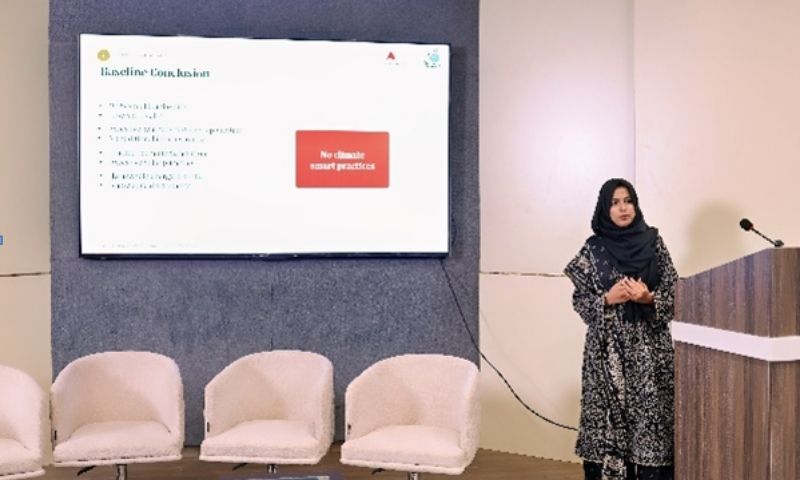
Ms Sundas Abbas, Senior Project Manager at SAWiE Ecosystems, presented an overview of the Climate Smart Village Initiative, explaining the programme approach to village level diagnostics, farmer engagement, digital monitoring and climate smart interventions.
Opening Keynotes
Dr Yusaf Zafar, Former Chairman PARC, highlighted the growing challenges facing Pakistan agricultural sector and the urgent need to strengthen resilience to climate change. He emphasised the importance of science, innovation and coordinated action to secure the country food and agricultural future.
Dr Khalid Mahmood, Co Founder SAWiE Ecosystems, highlighted the need to connect climate smart agriculture with farmers economics, technology, finance and markets. He emphasised that sustainable agriculture must become a viable business case for farmers while contributing to climate resilience and food security.
Farmers at the Centre
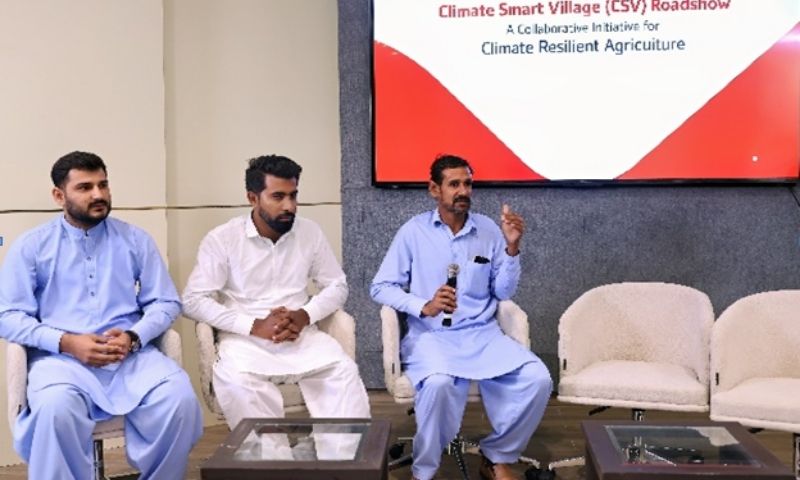
A central feature of the showcase was the Climate Smart Villages Farmer Talk, moderated by Dr Tasneem Khaliq, COO of SAWiE Ecosystems.
The session provided farmers with an opportunity to share their experiences directly and discuss what climate smart agriculture means in practice. The panel included Mr Kramat Ali from Vehari, Mr Imran Dogar from Faisalabad, and Mr Zeeshan Arshad from Layyah.
Their experiences reinforced that farmers are willing to adopt new practices when they see clear benefits in productivity, input efficiency, water savings, soil health and economic returns.
Practical Results on the Ground
Early results from the three villages demonstrate the potential of simple interventions combined with farmer engagement and advisory support
- In Layyah, one farmer produced the same wheat crop using four irrigations instead of six after applying biochar produced from his own cotton stalks.
- In Faisalabad, a sugarcane grower incorporated residues back into the soil instead of burning them, leading to measurable improvements across soil health indicators.
- The strongest cost to benefit return was observed in Layyah, where baseline soil conditions were poorest.
- More than 200 farmers have participated in training through field days, demonstrations and practical learning activities.
Panel Discussions
Panel 1: The Impact of the Climate Crisis on Pakistan Agriculture
The first major panel explored “The Impact of the Climate Crisis on Pakistan’s Agriculture”, moderated by Ms Sundas Abbas, Senior Project Manager, SAWiE Ecosystems.
The panel brought together perspectives from biotechnology, climate finance, farming, agricultural research and soil science:
- Dr Farrukh Hassan, CEO, The First Biotechnology Company
- Mr Aamer Hayat Bhandara, Progressive Farmer
- Dr Muqarrab Ali, Associate Professor, Muhammad Nawaz Shareef University of Agriculture, Multan
- Prof Dr Abdul Wakeel, Institute of Soil and Environmental Sciences, University of Agriculture Faisalabad
The discussion highlighted the increasing pressure being placed on Pakistan’s farming systems by rising temperatures, changing rainfall patterns, water scarcity, soil degradation and changing pest and disease pressures. The panel emphasised that Pakistan needs to move beyond reactive responses towards anticipatory and climate-resilient agricultural systems, supported by science, farmer knowledge, finance and appropriate technologies.
Panel 2: Climate Change and Sustainable Water Management
Water was the focus of the second panel, “Climate Change and Sustainable Water Management”, moderated by Ms Aimen Aziz, Operations Lead – Traceability, SAWiE Ecosystems.
The panel included:
- Dr Abubakr Muhammad, Centre for Water Informatics & Technology, LUMS
- Dr Abul Fazal, Progressive Farmer
- Dr Fahd Rasul, Associate Professor, University of Agriculture Faisalabad
- Engr Muhammad Hassan, Regional Director, PCRWR
The discussion recognised that water scarcity is becoming one of the defining constraints for Pakistan’s agricultural future.
Participants discussed the importance of measuring water use, improving irrigation efficiency, groundwater recharge, rainwater harvesting and better soil management. A recurring message was that technology alone is not enough. Better water management requires reliable data, farmer awareness, appropriate incentives and investment.
The discussions also highlighted the relationship between soil health and water resilience. Improving soil organic matter and soil structure can help increase infiltration and water retention, making healthy soil an important part of Pakistan’s water-management strategy.
Panel 3: Pathways to Enabling Climate-Smart Agriculture
The third panel focused on “Pathways to Enabling Climate-Smart Agriculture (CSA)”, moderated by Mr Abdullah Jahanzeb from FAO.
The panel brought together perspectives from sustainable cotton, agricultural technology, food supply chains, private-sector procurement and development finance:
- Rubab Zahra, Country Manager, OCA
- Dr Raheel Safdar, CEO, Chairman Sons
- M. Arshad, CEO, PAMICO Technologies
- Mr Usman Nawab, Procurement Manager, FAMS Foods
- Muddassir Shafique, International Finance Corporation (IFC)
The discussion focused on how climate-smart agriculture can move from individual projects towards commercially viable and scalable agricultural systems. Participants highlighted the importance of connecting farmers with buyers, technology providers, financial institutions and sustainable supply chains.
The message was clear: climate-smart agriculture needs an ecosystem around the farmer.
Farmers Need More Than Technology
Across the sessions, the barriers to adoption were discussed openly. Farmers highlighted the need for:
- Affordable and accessible machinery
- Trusted and quality agricultural inputs
- Direct links to buyers
- Reliable technical advisory
- Better access to farm-level information
- Finance that arrives before sowing rather than after it
These are not challenges that farmers can solve alone.
Scaling climate-smart agriculture will require stronger collaboration between farmers, researchers, banks, government, technology companies, NGOs, buyers and international development organisations.
Keynote: From Climate-Smart Agriculture to Climate Finance
The programme’s concluding keynote was delivered by Dr Khalid Mahmood, Co-Founder of SAWiE Ecosystems.
Dr Mahmood emphasised the importance of connecting farm-level climate action with finance, markets and measurable environmental outcomes. He highlighted the opportunity to use digital agriculture, regenerative farming, traceability and emerging carbon markets to create new economic opportunities for farmers while addressing Pakistan’s climate and food-security challenges. The central message was that:
Climate-smart agriculture must become a business case for farmers.
Chief Guest: Scaling the Vision
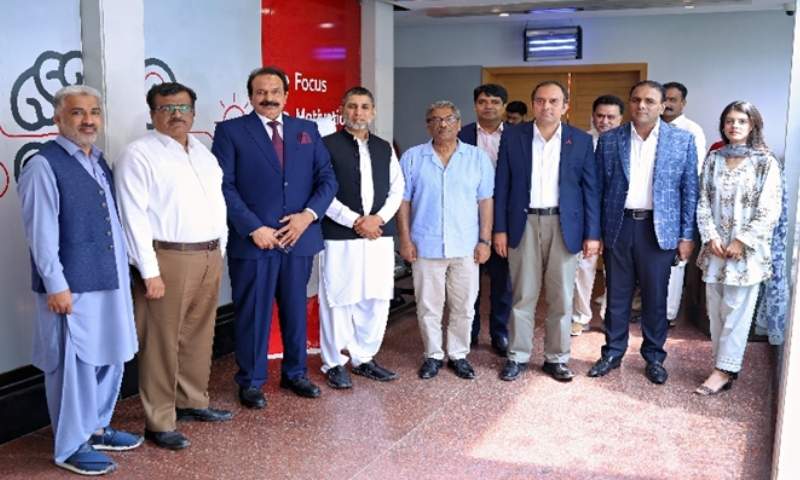
The event concluded with a speech from Prof Dr Ashfaq Ahmad, Vice Chancellor, Ghazi University, who highlighted the importance of collaboration between universities, farmers, financial institutions, industry and technology providers in addressing Pakistan’s agricultural challenges.
The event’s Vote of Thanks was delivered by Ms Hadia Hafeez, Vice President, Bank Alfalah, recognising the contributions of farmers, speakers, researchers, partners and participants.
From Village Action to a National Roadmap
The Climate-Smart Village Showcase was presented as more than an individual project event. It represents the beginning of a wider consultative process towards a national roadmap for climate-resilient agriculture in Pakistan. The ambition is to connect what happens at farm and village level with wider systems of digital agricultural advisory, monitoring and verification, sustainable supply chains, green finance and climate investment.
The experience from the three villages demonstrates that climate-smart agriculture can produce tangible results when interventions are grounded in local farming realities and supported by farmers themselves. The next challenge is to take what works in these villages and scale it across Pakistan’s farming communities. For SAWiE Ecosystems and Bank Alfalah, the message from the Lahore showcase was clear:
Climate resilience starts with the farmer, but scaling it requires the whole agricultural ecosystem to work together.
The Climate-Smart Village Initiative aims to build that ecosystem—one village, one farmer and one practical solution at a time.