Crimean-Congo Hemorrhagic Fever Zoonosis
A serious tick-borne viral zoonotic disease linked with livestock, human health and One Health prevention
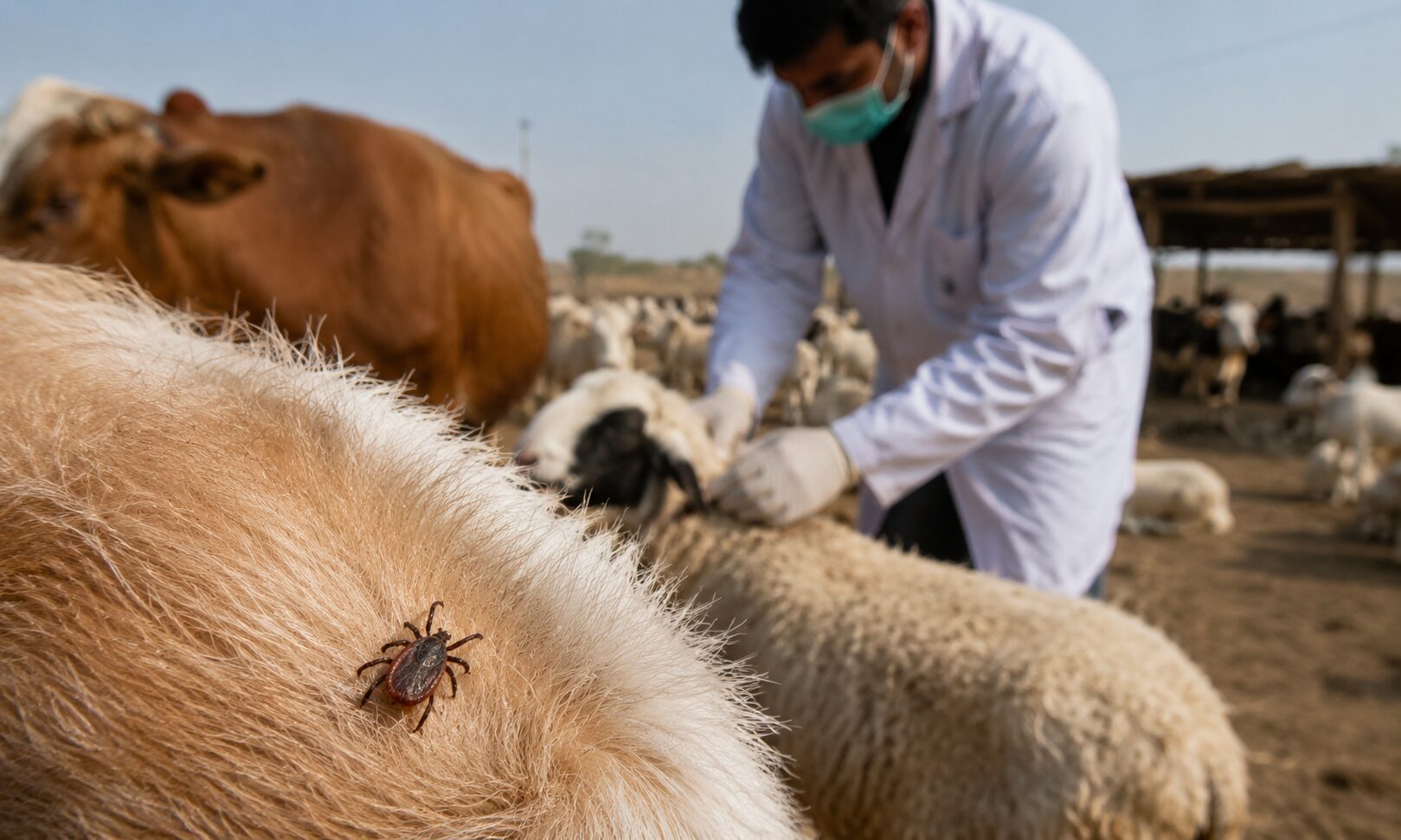
Crimean Congo Hemorrhagic Fever (CCHF) is a vector-borne viral zoonotic disease, communicable from animals including buffalo, cattle, sheep, etc. to humans via the bite of an infected tick. The CCHF virus is widespread in China, India, Pakistan, Afghanistan, Iran, and Iraq. CCHF has also been reported from Central Asian States, the Gulf States, Middle Eastern, Eastern Europe, Saharan and sub-Saharan African countries.
In Pakistan, in the year 2010, a total of 26 CCHF cases were reported, and out of it 03 people were reported as died. Since then, the CCHF cases have been on the rise in various areas of Pakistan. For example, in 2024 and 2025, a total of 61 and 82 cases were reported, respectively. In early 2026, 4 CCHF cases have been so far reported.
Why this disease needs attention
CCHF can move between ticks, livestock and humans. People working closely with animals, animal blood, tissues, slaughtering processes and suspected infected material need special awareness and protective measures.
Role of Hyalomma Ticks
The CCHF virus can infect a variety of wild and domestic mammals, avian species and ticks. Among various tick species, the Hyalomma ticks are the most commonly known vectors of the CCHF virus.
There are various modes of transmission of the CCHF virus from an infected tick to non-infected ticks. CCHF virus is commonly passed from an adult female tick to her larvae by trans-ovarian route. The venereal virus transmission in some vectors is also known.
The virus is also transmitted from infected adult Hyalomma ticks to the uninfected larval and nymphal Hyalomma ticks while co-feeding on a guinea pig. However, an important source of acquisition of the virus by the ticks is believed to be infected small vertebrates on which immature Hyalomma ticks feed.
Important Scientific Point
The ticks remain infected during all of their developmental stages and mature ticks may transmit the infection to large vertebrates, including livestock.
Ticks and Livestock in Pakistan
Hyalomma ticks quite commonly parasitize livestock in warm, arid and semiarid areas in Pakistan. Nymphs and unfed adults spend the dry and winter season in crevices in stone walls, stables, and weedy or fallow fields.
The immature ticks primarily parasitize birds. Hares and hedgehogs are secondary hosts, and rodents are rarely, if ever, infected. CCHF in animals is usually a non-clinical infection, but an animal may have the virus in its blood and upon bite of tick can infect it.
In a study in a South African rural community, antibody prevalence in humans on farms increased with age and was correlated with the handling of lambs. Overall, a greater number of older animals were found antibody-positive than the animals less than one year of age.
The wild ground-feeding birds may be frequently infected with immature ticks. Ostriches can also be infected by the virus.
Quite high levels of CCHF antibodies in sera of livestock and wild vertebrates using competitive ELISA are reported. Rhinoceros, giraffes, wild buffaloes, monkeys etc. may harbor the CCHF virus as these animals were CCHF virus antibody-positive.
VNV Insight
CCHF should be viewed through a One Health lens because livestock management, tick control, public awareness, hospital infection control and environmental conditions are all connected.
Human Infection and Diagnosis
Humans may be infected by direct contact with infected blood or tissues from CCHF infected livestock or via the tick bite. Some outbreaks are possibly associated with import of CCHF virus-infected livestock.
This disease is diagnosed by enzyme-linked immunosorbent assay or enzyme immunoassays by detecting IgG or IgM antibodies against CCHF virus. Polymerase Chain Reaction (PCR) is also used for detection of viral genome from the blood of patients suspected for CCHF.
Higher Risk Groups
- Agricultural and livestock workers
- Animal handlers and butchers
- Veterinary professionals
- Medical and paramedical staff
Key Transmission Concerns
- Tick bite
- Contact with infected blood
- Contact with infected animal tissues
- Hospital-based spread without infection control
Need for One Health Coordination
Collaborative and coordinated measures by the human, animal, and environmental health authorities following a One Health approach are needed to control zoonotic diseases.
Plasma therapy and treatment with interferon and interferon inducers helps in disease treatment. Vaccines against CCHF virus are used in some countries.
Preventive and Control Measures
Control of ticks in animals
Since infected domestic livestock pose a major threat to human health, control of ticks in animals is important. Tick control helps in decreasing the incidence of CCHF in endemic areas.
Survival of the ticks in the environment is of complex nature and depends on several factors such as rainfall and maintenance of required microclimate with a high relative humidity and also on the transpiration of plant leaves.
Generally, the ticks are more active during the warm season provided there is sufficient rainfall. However, in some species of ticks, the larval and nymph stages are also active in milder weather and this affects the duration and timing of control programs.
Tick Control Measures Mentioned in the Article
- For severely parasitized animals, individual treatment with special chemical formulations, acaricides, suspended in a greasy base is suggested.
- Plant oil-based acaricides such as Neem oil can provide an eco-friendly alternative to chemicals.
- Since ticks may develop resistance to acaricides, the efficacy of acaricides needs to be monitored.
- Methods like burning pastures are still in practice to help control tick population.
- Cultivation of the land and improved drainage help in reducing the prevalence of tick populations.
- Selection of cattle with a high natural resistance to tick infestations is a good control strategy.
- Vaccines against some species of ticks are in use.
Precautions for Occupational Risk Groups
People at occupational risk include agricultural and livestock workers, and medical and paramedical staff must take proper precautions while handling material suspected of CCHF.
Community-wide insect and arthropod control strategies need to be developed. Houses, vacant cabins, and campsites should be protected by insect screens on doors and windows. Further, such sites should not attract or support the breeding of potential vectors.
Contact with infected arthropods should be avoided by the use of insect repellent or protective clothing.
Hospital and Public Health Warning
Nosocomial spread could be avoided by adequate infection containment. Proper awareness of the hospital staff on the transmission, spread, and prevention of the disease is important.
Conclusion
In conclusion, CCHF can be prevented by vector control and following precautionary measures. A One Health approach involving concerted efforts of human, animal, and environmental health professionals can lead to effective control of CCHF.