A Forgotten Truth in Pakistan’s Academic Landscape
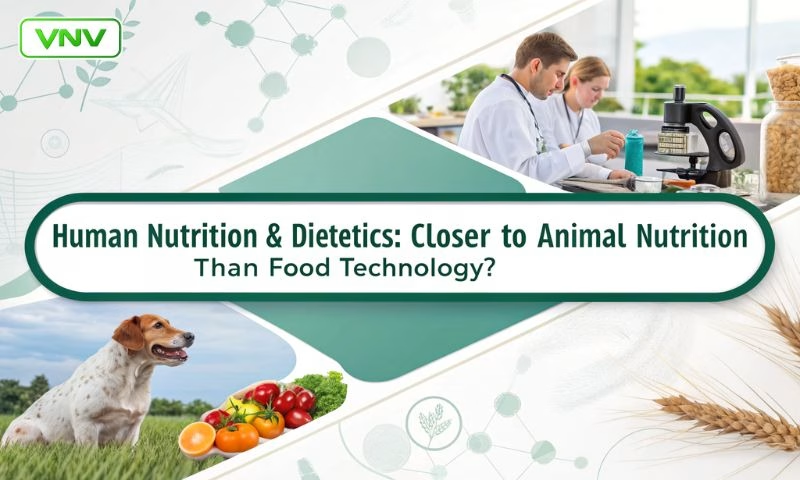
In Pakistan’s rapidly evolving education sector, Human Nutrition and Dietetics (HND) is gaining traction as an essential academic discipline tied to public health, disease prevention, and well-being. But behind the rising popularity of HND lies a surprising academic truth: Human Nutrition has historically been and remains more closely linked to Animal Nutrition than to Food Technology.
While this may seem counterintuitive at first, a closer look reveals how deeply connected these fields are scientifically, academically, and even institutionally.
Shared Science: More Similar Than Different
When we speak of nutrition, whether for humans or animals, we’re essentially talking about the same biological language. Nutrient metabolism, digestion, absorption, energy production, and cellular function operate under universal biochemical principles.
Experts highlight that monogastric animals (like chickens and pigs) share similar digestive systems with humans. Even ruminants (like cows) only differ anatomically due to the presence of a rumen, which allows fermentation—yet the underlying metabolic and biochemical pathways remain largely comparable.
“The biochemistry of nutrient absorption and energy utilization is fundamentally the same in both humans and animals,” write Anderson & Lee (2017) in Comparative Monogastric Nutrition.
Academic Roots: Nutrition Was Born in Animal Sciences
Before HND became a formal degree in Pakistan, universities offering PhDs in Nutrition housed their programs in the faculties of Animal Husbandry, especially at leading agricultural institutions. Their scholars conducted advanced research on metabolic disorders, micronutrient functions, and nutrient energy systems, many of which directly apply to human physiology.
Khan et al. (2020), in their review of Pakistani nutrition research, point out that Animal Sciences departments have historically led the way in biochemical and metabolic studies related to nutrition. In contrast, Food Technology programs focus more on food safety, preservation, and industrial processes.
“Food Scientists typically study food structure and stability, while Nutritionists delve into what happens after food enters the body,” explains Smith & Jones (2018) in Nutritional Biochemistry Across Species.
A Global Model: No Borders Between Species
This isn’t unique to Pakistan. Across Europe, the U.S., and Australia, animal nutrition experts are frequently involved in human health research, particularly in areas like obesity, malnutrition, and gut health.
International journals are filled with studies where veterinarians, animal physiologists, and nutritionists collaborate on solving human nutrition problems using animal models, which are scientifically valid due to similar metabolic processes.
As Brown et al. (2019) note, “The feed-to-food research model connects both animal and human nutrition in a cycle of mutual insight.”
Misconceptions in Pakistan: The Titles Trap
Unfortunately, in Pakistan, the terms “Food Scientist,” “Nutritionist,” and “Dietitian” are often used interchangeably, leading to confusion in both academic and public health settings. This often results in misplaced expectations when assigning research or evaluating theses in HND departments.
Ahmed & Fatima (2021) call for urgent academic distinction and public awareness: “Not understanding the differences between these professions dilutes their purpose and reduces interdisciplinary value.”
The Way Forward: Recognize the Overlap, Respect the Difference
It’s time we acknowledged that Human Nutrition is deeply rooted in Animal Nutrition, and not an extension of Food Technology. This awareness isn’t just about academic correctness—it influences who we hire, who we assign as external examiners, and who we consult in nutrition-related health policy.
Promoting this understanding will foster more credible, scientifically sound collaborations and ultimately benefit the health and education systems of Pakistan.
References
– Anderson & Lee (2017) – Comparative Monogastric Nutrition
– Wilson (2015) – Human and Animal Metabolic Science
– Khan et al. (2020) – Nutrition Research in Pakistan’s Agriculture Universities
– Smith & Jones (2018) – Nutritional Biochemistry Across Species
– Brown et al. (2019) – Interdisciplinary Models in Nutrition Research
– Garcia & Patel (2021) – Animal Science’s Role in Global Health
– Ahmed & Fatima (2021) – Professional Boundaries in Nutrition Disciplines