MAARIA RAHEEL SPAUL
Thank you for reading this post, don't forget to subscribe!A Institute of Microbiology, University of Veterinary and Animal Sciences, Lahore.
Silent milk thief: How bovine mastitis is draining dairy industry

Imagine pouring a bucket of milk down the drain every day – painful, right? For many dairy farmers, it’s a harsh reality encountered by them caused by bovine mastitis. Bovine mastitis in undoubtedly a noxious disease in dairy cows affecting the quality and quantity of milk, loss of animals, increased treatment costs and is also economically very drastic. The disease is caused by certain physical, chemical and biological factors among which bacteria are considered as principal invaders of cow’s mammary glands.
The teats of the animal become extremely painful, color, odour and consistency of the milk also changes and in severe cases there is the appearance of blood in milk too. The infection transfers from animal to animal to the entire herd which is detrimental to the economics as well as to the public health who have major dependence on milk to fulfill their dietary requirements. Moreover, there is a lack of timely detection of this disease as a result of which its mild form i-e Sub-clinical converts to severe form i-e Clinical Mastitis.
Why early detection matters?
The mild form of disease is silent and often goes unnoticed. Consequently, much of the milk reaching to the consumers is not of good quality and have many bacteria in it which is detrimental to public health too. Moreover, without early detection, the infection spreads from animal to animal and the entire herd is put on the verge of survival.

BOVINE EPHEMERAL FEVER VACCINE K-KB
Effective Immunity to
Cattle Against
CBoviné Ephemeral Fever.
Therefore, it is imperative to create awareness among the farmers about the importance of prior screening of animals as well as the milk before they reach to the consumers. This would also have a direct impact in strengthening immunity among the dairy animals as they would be saved from the harms of prolong and irrelevant treatment strategies on the part of farmers.
Imperative demand: Routine monitoring of animals and their milk
The regular monitoring of cow’s health and milk quality is essential for sustainable livestock and for this purpose structured monitoring programmes should be implemented to identify the early onset of mastitis. The udder swelling, hardness and redness should be monitored daily. Farmers should keep track of behavioral changes in the cows. The quality of milk should be accessed after each milking.
Above all, it is imperative to conduct preliminary screening tests of the milk in order to ensure the absence of mastitis in the milk reaching to the consumers.
For this purpose, relevant awareness and training should be provided to the farmers under strict
supervision of veterinary practitioners. Rapid, on-farm tests should be introduced in the farms
which offers cost-effective, early diagnosis of mastitis leading to fast decision making for
targeted treatment which in turn diminishes the irrational use of antibiotics.
Provision of On-farm culture kits and screening reagents
The solution lies in the provision of On-farm culture kits and reagents to conduct California mastitis test is required. California Mastitis test requires a use of single reagent for preliminary screening of milk therefore it is an cost-effective method. The principle is based on detecting infection indicated by an increase in white blood cells.

Ultravec BEF Vaccine
Ultravec BEF Vaccine
Active Immunization against EPHEMERAL Fever
Fight 3DAY Sickness
Additionally, the method is currently in practice of providing ready-made culture plates to the farms with an incubator to identify mastitis causing bacteria so that the relevant choice of antibiotics can be made without any delay thereby preventing the disease to develop into its severe form.
How screening tests helps in Mastitis control?
Screening tests favors better targeted treatment, effective herd management by isolating the cows having severe form of disease, and reduces economic losses in a way that animals can be saved from slaughtering.
Criteria of characterization of milk samples:
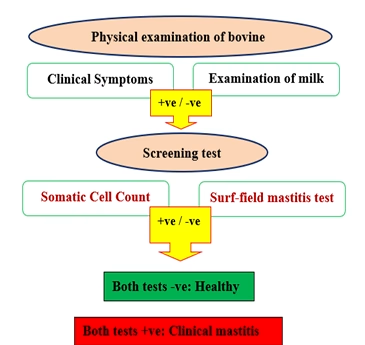
Record keeping and farm management
The data of all the infected animals in a particular farm should be compiled and special emphasis should be given to the segregation of infected animals from the healthy ones. Moreover, for the maintenance of herd, a systemized culling policy should be considered.
Conclusion: Mastitis prevention done right
Investing in on-farm rapid, diagnostic tools along with better herd management and milking practices will reduce the drastic economic losses due to mastitis. The goal is not only to prevent mastitis but also the certainty of enhanced quality milk production, sustainable livestock, and a more profitable future for the farmers.