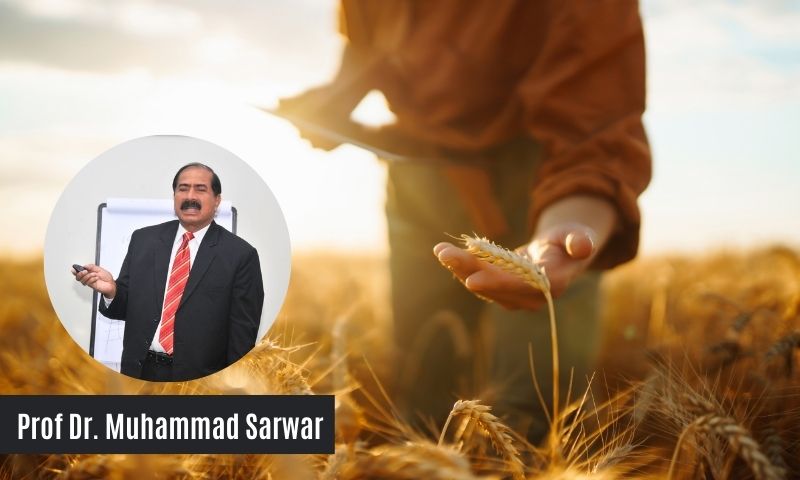
Professor Dr. Muhammad Sarwar
Dean of Postgraduate Studies and Research, The University of Lahore
Introduction
Agriculture remains the backbone of Pakistan’s economy. Nearly 65% of Pakistan’s population is directly or indirectly dependent on farming, either through crop cultivation or livestock rearing. This sector provides food security, sustains rural livelihoods, supports exports, and supplies raw material for industries. Despite its critical role, agriculture in Pakistan is under severe pressure. Rising input costs, unpredictable weather, shrinking profitability, high cost of electricity, and government-imposed price capping threaten the survival of farmers.
If immediate corrective measures are not taken, the backbone of the nation risks collapse. The stark reality is that 65% of Pakistan’s population could fall below the poverty line, triggering an economic and social crisis of unprecedented magnitude. The Global Perspective
How other nations protect farmers? No country in the world has achieved food security without protecting its farmers. Developed and developing economies alike have long recognized the vulnerability of agriculture and the need to shield farmers from market volatility.
1. The United States provides billions of dollars in annual farm subsidies under programs that stabilize farm income, reduce production risks, and ensure national food security.
2. The European Union dedicates nearly 40% of its total budget under the Common Agricultural Policy (CAP) for agricultural subsidies and farmer welfare.
3. Neighbouring India protects its farmers with fertilizer subsidies, free or cheap electricity for tube wells, fuel concessions, and guaranteed procurement of crops at Minimum Support Prices (MSPs).
In contrast, Pakistani farmers face rising costs of seed, fertilizer, pesticides, machinery, diesel, feed, and veterinary care, while being forced to sell their produce under artificial price caps. This imbalance discourages production, undermines competitiveness, and endangers national food security.
Pakistan’s policy dilemma
There are two pathways ahead on treading one of them we can solve farming community issues, safeguarding our farming community welfare and country’s food security.
1. The subsidy support model
The most effective and globally consistent pathway is to introduce targeted subsidies in both the crop and livestock sectors. Such subsidies should not be seen as expenditure, but as investment in food security and poverty reduction.
Key areas for subsidy support:
1. The subsidy support model
The most effective and globally consistent pathway is to introduce targeted subsidies in both the crop and livestock sectors. Such subsidies should not be seen as expenditure, but as investment in food security and poverty reduction.
Key areas for subsidy support:
a. Input subsidies: Fertilizers, seeds, pesticides, electricity, and diesel should be subsidized to reduce the cost of cultivation
b. Livestock subsidies: Subsidized feed, vaccines, and veterinary care to stabilize milk, meat, poultry, and egg supply
c. Financial support: Provision of low-interest agricultural credit, crop insurance, and disaster relief funds
d. Guaranteed procurement: Establishment of MSPs for staple crops like wheat, rice, maize, cotton, and sugarcane to ensure fair returns
e. Rural infrastructure: Investment in irrigation, storage, and transport to reduce postharvest losses and improve market access.
This pathway would align Pakistan with international practices, strengthen rural livelihoods, and stabilize food supply.
2. The free-market model
If fiscal limitations make subsidies difficult, then Pakistan must move towards a free and fair market system. In such a system, farmers must be allowed to sell their produce at competitive prices, across districts, and provinces, free from arbitrary government capping.
Key steps to enable a free market
a. Elimination of price capping: Farmers should not be compelled to sell wheat, flour, sugar, milk, poultry, or other products below production cost.
b. Market access: Farmers should have freedom to sell produce to domestic traders, processors, and exporters.
c. Competition in inputs: Liberalization of input markets (seed, fertilizer, pesticides) to prevent monopolies and ensure affordable prices.
d. Regulation of cartels: Government’s role should focus on preventing cartelization, hoarding, and black-marketing, rather than suppressing farm-gate prices.
e. Technology and market signals: Allowing farmers to respond to demand patterns and encouraging diversification through technology adoption.
f. Creating of farmers’ markets: The Government must establish farming community markets surrounding their farms and farming community be allotted shops wherein they can sell their commodities.
This pathway would empower farmers, stimulate competition, and attract private sector investment.
Consequences of inaction
If Pakistan’s policymakers fail to act decisively, the repercussions will be severe and longlasting:
1. Rural poverty explosion: With most farmers already struggling, suppressed farm incomes will push millions below the poverty line.
2. Food insecurity: Farmers will reduce crop cultivation and livestock rearing due to losses, forcing Pakistan to depend on costly imports.
3. Rural-urban migration: A collapse in agriculture will push unemployed rural workers into cities, aggravating urban poverty and unemployment.
4. Social unrest: Widespread poverty in rural areas can lead to unrest, instability, and weakening of social fabric.
5. Economic decline: Agriculture contributes nearly 20% to GDP; its decline will destabilize the entire economy and increase trade deficits.
Policy Recommendations
The government of Pakistan must make agriculture a top national priority. Two clear pathways exist:
1. Adopt subsidy support as done by major economies worldwide, targeting key crops and livestock sectors.
2. Allow a free-market system if subsidies are not financially feasible, ensuring fair returns for farmers without artificial price capping.
3. A hybrid model may also be considered, providing subsidies and MSPs for essential food crops (wheat, rice, sugarcane, maize) to safeguard national food security, while allowing other sectors like poultry, fruits, and vegetables to operate in a competitive free market environment.
Conclusion
Pakistan’s future depends on its farmers. They are the silent guarantors of national survival, feeding the people and sustaining rural livelihoods. Ignoring their plight today will create poverty, food shortages, and social instability tomorrow. If the government acts decisively through subsidies or free market reforms, Pakistan will not only achieve food security but also price security. Protecting farmers is not charity; it is the most strategic investment a nation can make in its stability, prosperity, and independence.
Author’s Note
I write these words not only as a professor and expert of agriculture, but also as a small farmer who directly faces these realities. The challenges described here are not abstract or theoretical; they are lived experiences. Rising input costs, unjustified price capping, and the imbalance between production and profitability are realities I encounter personally, season after season. This article, therefore, is not written for the sake of writing. It is a practical call to action, rooted in both academic understanding and firsthand farming experience. The advice offered is realistic, implementable, and urgently needed. Pakistan’s policymakers must understand that the fate of millions of farmers is not only at stake and if not checked properly, the fate of the nation will also be at stake.