Mahrukh Babar
Department of Pharmacy, Abasyn University, Islamabad, Pakistan
Corresponding author: mahrukh.babar@abasynisb.edu.pk
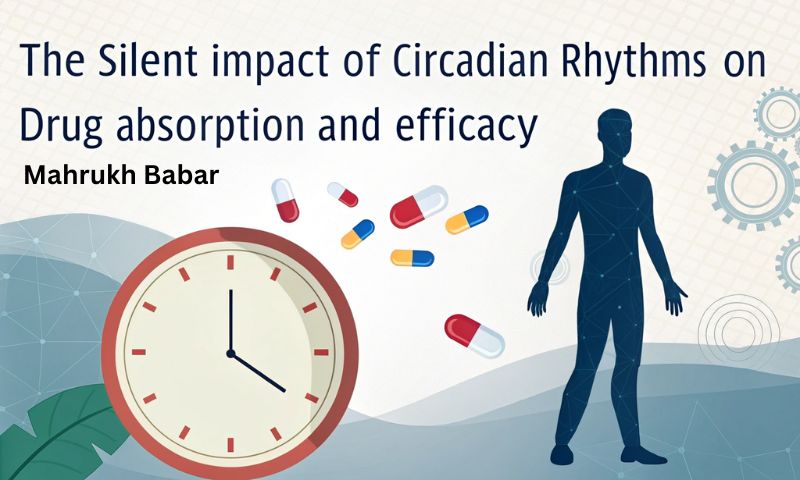
Introduction: The human body functions on a 24 hour circadian rhythms. These circadian rhythms are regulated by recurring day/night cycles, enable living things to anticipate and effectively react to a dynamically changing physiological events such as sleep, hormone secretions and even drug absorption and metabolism (Reddy et al., 2018). This rhythmic event significantly affect pharmacokinetic properties of drugs, how they are absorbed, distributed, metabolized and excreted out from the body (Mauvoisin et al., 2014).
Absorption of drugs depend on physiological processes of administration. Key transporters are expressed in such a way that their levels reach peak level at specific time of the day (Dong et al., 2020). For example, medications taken at night are metabolized differently then take in the morning, effecting its efficacy and safety profile. Chronopharmacology is an important discipline in this regard which helps us understand how circadian rhythms can optimize therapeutic outcomes of drugs by reducing their side effects and enhance their efficacy.
This field has shown promising results in hypertension, stress management, rheumatoid arthritis and asthma where symptoms severity varies by time of the day (Ohdo et al., 2007). For instance, a recent study of children with asthma who received theophylline at either 06:00 or 21:00 revealed that the drug’s serum levels were doubled when the dose was given at 21:00. Additionally, this nightly dosage schedule coincided with the natural dyspnea cycle, peaking during the most severe symptoms (Dallmann et al., 2014).
Conclusion
By aligning body’s rhythms with drug treatments, better therapeutic outcomes can be obtained with reduced toxicity. Despite all these benefits, chronopharmacology is not integrated widely in clinical practice and needs more patient specific research on drug-time data. Also there is a need for awareness among physicians about the power of body clock in pharmacotherapy.
References:
1. Dallmann, R., Brown, S. A., & Gachon, F. (2014). Chronopharmacology: new insights and therapeutic implications. Annual review of pharmacology and toxicology, 54, 339-361.
2. Dong, D., Yang, D., Lin, L., Wang, S., & Wu, B. (2020). Circadian rhythm in
pharmacokinetics and its relevance to chronotherapy. Biochemical
Pharmacology, 178, 114045.
3. Mauvoisin, D,Wang, J, Jouffe, C., Martin, E., Atger, F., Waridel, P., & Naef, F.
(2014). Circadian clock-dependent and-independent rhythmic proteomes implement
distinct diurnal functions in mouse liver. Proceedings of the National
Academy of Sciences, 111, 167-172.
4. Ohdo, S. (2007). Chronopharmacology focused on biological clock. Drug metabolism and pharmacokinetics, 22(1), 3-14.
5. Reddy, S., Reddy, V., & Sharma, S. (2018). Physiology, circadian rhythm.