Dr Ali Butt (Veterinary officer)
Livestock And Dairy Development Department, Punjab.
alibutt11702@gmail.com
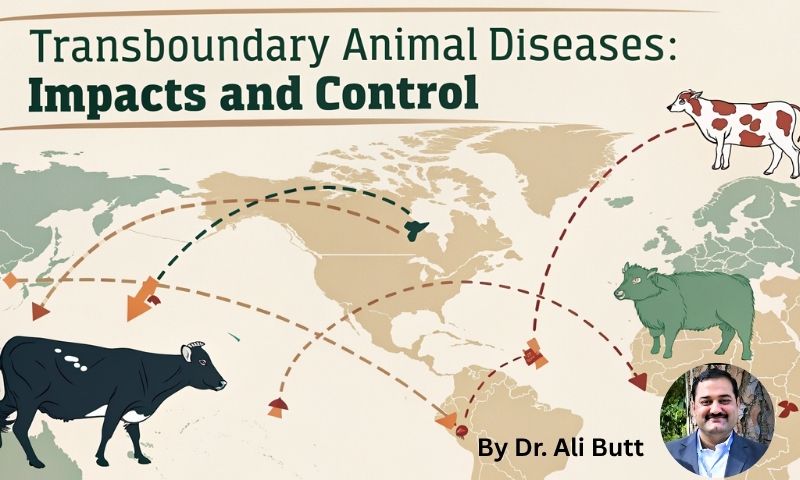
Transboundary animal diseases are defined as “those diseases that are of significant economic, trade and/or food security importance for a considerable number of countries; which can easily spread to other countries and reach epidemic proportions; and where control/management, including exclusion, requires cooperation between several countries” (FAO).
These diseases are highly contagious and transmissible regardless of international boundaries. This rapid spread causes serious socio-economic and public health consequences. These incidents can stop international trade of animals and their products and endanger food security across the globe.
Vaccine Insights by Dr. Ali Butt: Benefits, Safety & Latest Research
Click Here
FAO’s Emergency Prevention System for animal health focuses on some 12-14 diseases of a transboundary nature such as foot and-mouth disease, rinderpest, contagious bovine pleuropneumonia, sheep and goat pox, peste des petits ruminants, highly pathogenic avian influenza, Rift Valley fever, Newcastle disease, African and classical swine fever, equine encephalitidies, and under certain circumstances rabies and brucellosis.
Livestock Production Enhancement
Click Here
The impacts are of serious nature. As for as animal health and production is concerned, these diseases cause high morbidity and mortality. It results into decreased production and increased losses. Due to international trade restrictions, movement of animals and their products is halted. It results into loss of market access and economic losses for exporting countries. People become jobless and poverty increases. Disease control and prevention cost increase the burden on economic chain.
On the other hand, importing countries face food shortage and hunger. Scarcity of food results in increased food price. Some diseases are of zoonotic importance and risk to human health. This put psychological impact and burden on public health facilities and infrastructure. All these factors contribute to panic and social unrest across the globe.

The control is undoubtedly difficult due to the nature of spread through air, migratory birds and human sources. However, international collaboration between governments and N.G.O.s can make the task easy. The monitoring and surveillance of diseases are key to control the diseases. Monitoring of animals and collection of data of disease trends in an area for future planning and prevention is a must that can help timely intervention and stop further expansion. Moreover, biosecurity measures at farm level are the most important tool to control further spread of disease. By limiting the access to utensils and tools would keep the infection away.
Livestock Crises Management
Click Here
Hygienic measures and sanitation practices limit the disease transmission. Use of disinfectants destroy the pathogen from the place. Dur ing unavoidable movement of animals, Quarantine facilities and isolation always help to minimize the contact between new animals and already present animals. Waste management at infected farms stop further dissemination of germs. Last, but not the least, microorganisms always go through mutations to keep them alive in odd environment and create problems. Therefore, continuous research activities to find out the solution of the problem is key to success.