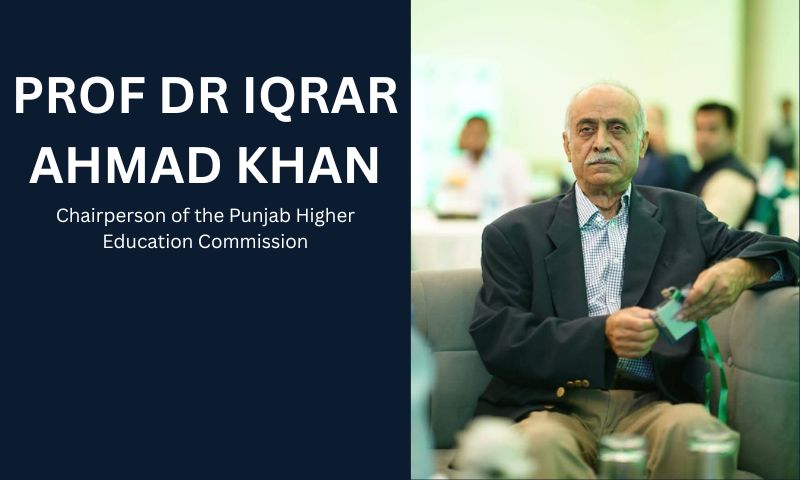
Prof Dr Iqrar Ahmad Khan
Thank you for reading this post, don't forget to subscribe!Chairperson of the Punjab Higher Education Commission (PHEC)
LAHORE: Chairperson of the Punjab Higher Education Commission (PHEC) Prof DrIqrar Ahmad Khan has unveiled an ambitious five-year “Governance & Institutional Reforms Strategic Plan/Activity Roadmap (2025–29),” saying it is designed to overhaul governance, enhance academic standards and research, and position Punjab’s universities on the global stage.
Speaking to The News, Prof DrIqrar Ahmed Khan said the plan marks “a decisive shift towards transparency, creativity and relevance in Punjab’s higher education.” He added that the strategy balances quantity with quality, emphasising PhD production, interdisciplinary research and stronger societal engagement.
He disclosed that the roadmap rests on seven broad priorities: governance reform and institutional autonomy, quality enhancement, teaching and research innovation, performance-linked funding, civic engagement, human capital development, and technology-driven internationalisation. “We have identified clear targets to ensure universities not only expand but also excel,” he said.
According to the chairman, syndicates, boards of governors and statutory bodies in public Higher Education Institutions (HEIs) will be restructured on merit and inclusivity by 2027, while accountability frameworks for universities and vice chancellors will be in place by 2026. He said PHEC would work closely with the Higher Education Commission and provincial Higher Education Department to ensure biannual policy reviews, integrated funding and routing of federal programmes through PHEC.
Prof. Khan noted that the commission is institutionalising outcome-based education, Quality Enhancement Cells and internal quality circles across all public and half of private HEIs by 2026, guided by the Pakistan Standards and Guidelines for Quality Assurance (PSG-2023). A province-wide Higher Education Development dashboard integrating ERP, LMS and campus management systems is expected by 2027, while at least 150 research projects will receive peer-reviewed funding annually. Employer satisfaction surveys will also assess graduate employability.
He said academic productivity and research visibility would be boosted through funding for more than 200 programmes by 2029, creation of 10 interdisciplinary research clusters by 2026, and doubling of international publications over the next five years. Targets also include placing Punjab’s universities among the world’s top 300 in subject rankings, supporting 500 faculty and student startups, and setting up ISO/PNAC-certified laboratories in every university by 2028.
Prof. Khan explained that a performance-based funding model will be introduced in all public HEIs by 2027, with allocations favouring underserved regions. Universities will be encouraged to build comprehensive data dashboards covering academic life cycles, alumni networks and community outreach. He said PHEC plans to forge 500 partnerships between universities, industry and civil society, integrate service learning into 70% of programmes by 2028, and involve over 100,000 students annually in civic initiatives.
The chairman said leadership and faculty capacity are central to the roadmap. “We will train 100 vice chancellors, pro-VCs and deans through a competitive process by 2026,” he revealed, adding that over 10,000 faculty members will complete professional development in pedagogy and digital literacy by 2029. PHEC also aims to host 300 international and diaspora scholars and establish teaching resource centres in green and blue universities.
Discussing the plan’s digital dimension, Prof. Khan said PHEC will roll out AI-enabled smart campuses, expand online and distance learning to 70% of HEIs by 2028, and scale MOOCs and global e-learning platforms to reach 500,000 learners by 2027. By 2029, at least 10 universities are expected to enter the QS Top 500 global rankings. “This roadmap is more than an administrative document; it is our pledge to place knowledge, innovation and civic responsibility at the heart of Punjab’s universities,” Prof. Khan said, urging academia, industry and policymakers to join hands to ensure sustainable growth and social impact in the higher education sector.