TANDOJAM & LANZHOU, Sept 24 (China Economic Net) – A recent field trial in Sindh, Pakistan, has shown promising results as three Chinese flaxseed varieties – Longya-10, Longya-14, and Longxuan-1 – significantly outperformed Pakistan’s local variety Ilsi-90 when grown with balanced NPK and boron fertilization.
Thank you for reading this post, don't forget to subscribe!The joint study, conducted by the Gansu Academy of Agricultural Sciences (GAAS) and Sindh Agriculture University (SAU), seeks to tackle Pakistan’s shrinking flaxseed cultivation. At present, the country’s average yield (692 kg/ha) is well below that of major producers such as China (1,000 kg/ha) and Canada (1,385 kg/ha).
Using a randomized block design with three replications and five fertilizer treatments, researchers collected data on key agronomic traits, including plant height, number of branches, seed yield, and nutrient concentrations in both leaves and seeds.
Among the tested varieties, Longya-14 delivered the best performance. Under optimal fertilization, plants reached 78.5 cm in height, developed 17 branches, and produced 12 seed pods per plant. The variety also recorded a 1,000-seed weight of 7.5 g, grain yield of 1,089.3 kg/ha, and oil content of 40.12%. Additionally, its leaves and seeds showed higher uptake of nitrogen (N), phosphorus (P), and potassium (K) compared to Ilsi-90. While the local variety displayed a slightly higher leaf boron concentration under ideal conditions, it lagged behind in overall productivity and nutrient efficiency.
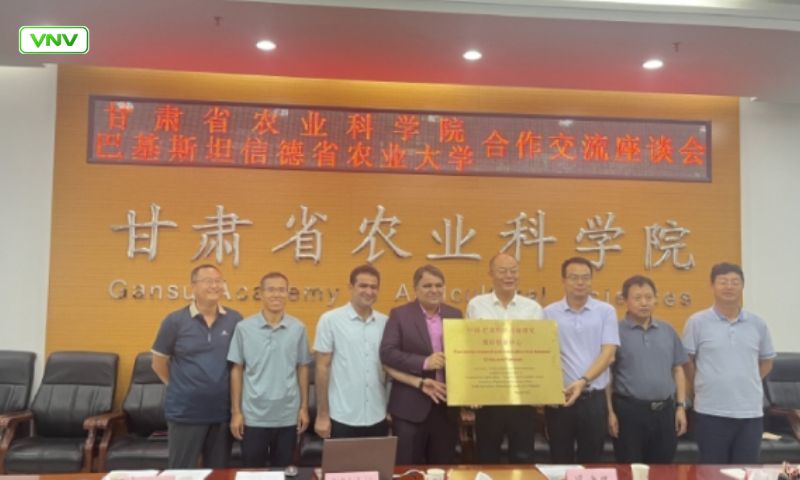
In July 2024, GAAS and SAU launched the Flax Study Research and Innovation Hub to strengthen cooperation on flax research between China and Pakistan.
The findings, published in the Journal of Ecological Engineering (August 2025), confirm that integrating balanced NPK and boron fertilization with nutrient-responsive Chinese varieties – especially Longya-14 – can significantly boost flaxseed yield and quality in Sindh’s nutrient-deficient soils. Researchers believe this approach offers a viable pathway to revitalize Pakistan’s flaxseed industry.