Dr. Shahzad Naveed Jadoon
Thank you for reading this post, don't forget to subscribe! 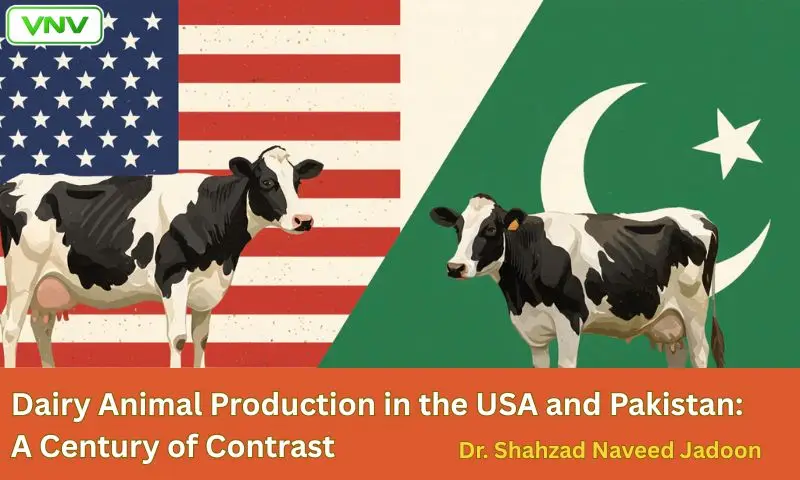
The global dairy landscape has shifted dramatically over the past century. While both the United States and Pakistan began the 20th century with largely traditional dairy systems, their journeys since then have diverged significantly. Today, the U.S. dairy industry stands as a model of high efficiency and scientific innovation, while Pakistan’s dairy sector continues to struggle with low per-animal productivity. This article compares the status of dairy animal production in 1920 and today and explores the key reasons behind the USA’s remarkable progress.
Then and Now: A Historical Comparison
Dairy Production in 1920
In 1920, both the U.S. and the region now known as Pakistan relied on traditional dairy systems. Farmers milked indigenous cows or buffaloes by hand, with little or no understanding of nutrition, genetics, or disease control.
|
Metric |
USA (1920) |
Pakistan (1920) |
|
Avg. milk yield per cow |
~2,000 liters/year |
~400–500 liters/year |
|
Technology level |
Manual |
Manual |
|
Genetic quality |
Low |
Low |
|
Animal health systems |
Rudimentary |
Rudimentary |
Dairy Production Today (2025)
A century later, the difference is stark. The U.S. dairy industry produces over 100 million tons of milk annually, with far fewer animals than Pakistan, thanks to exceptionally high per-cow yields. Pakistan, despite being one of the largest milk producers globally, depends on the sheer number of animals rather than productivity.
|
Metric |
USA (2025) |
Pakistan (2025) |
|
Avg. milk yield per cow |
~10,500 liters/year |
~2,000–2,500 liters/year |
|
Total dairy animals |
~9 million |
~55 million |
|
Milk processing rate |
>95% |
<10% |
|
Technology use |
Advanced/Automated |
Mostly traditional |
Why Has the U.S. Dairy Sector Succeeded?
1. Superior Genetics and Breeding
The U.S. heavily invested in selective breeding, particularly Holstein-Friesian and Jersey cattle. Through artificial insemination and genomic tools, only the best genetics were passed on.
2. Scientific Feeding and Nutrition
Balanced rations, total mixed rations (TMR), silage, and feed additives are standard in the U.S., leading to healthier animals and higher milk output.
3. Mechanization and Automation
From robotic milking systems to temperature-controlled barns and real-time health sensors, automation has drastically reduced labor and increased consistency.
4. Animal Health and Welfare
Vaccination programs, mastitis control, and herd monitoring software ensure optimal animal welfare and prevent disease outbreaks.
5. Cold Chain and Processing Infrastructure
With nearly all milk chilled, processed, and packaged, the U.S. adds enormous value to raw milk through products like cheese, yogurt, and butter, fueling exports.
6. Education, Research, and Policy
American universities, extension services, and USDA-backed programs offer continuous support and innovation to farmers. Incentives and subsidies also play a role.
Pakistan: A Sector of Untapped Potential
Pakistan’s dairy sector faces numerous structural issues:
-
Predominance of low-yield animals (non-descript cows and buffaloes) -
Lack of awareness and training among smallholder farmers -
Poor access to veterinary services and artificial insemination -
Limited silage and fodder availability -
Underdeveloped cold chain and milk collection systems
Yet, there is potential. With improvements in:
-
Genetics and AI services -
Commercial dairy farming -
Farmer education and training -
Fodder cultivation and feed formulation -
Public-private partnerships in processing and logistics
Conclusion
The contrast in dairy animal production between the United States and Pakistan is a case study in the power of investment, innovation, and institutional support. While the U.S. produces more milk with fewer animals, Pakistan continues to rely on quantity over quality. Bridging this gap will require serious commitment to modernizing the sector—from the genetics of animals to the policies that support farmers. The future of dairy in Pakistan depends not on more animals, but on smarter, more productive farming systems.