A deep dive into the pioneering work of Ali Hassan Nawaz, from Prof. Li Zhang’s group in Guangdong Ocean University, whose research is unlocking nature’s own solutions to the billion-dollar threat of heat stress in the poultry industry.
Thank you for reading this post, don't forget to subscribe!As global temperatures rise, a silent crisis is unfolding on farms worldwide. The poultry industry, a cornerstone of global food security providing affordable protein to billions, is facing an existential threat: heat stress. This environmental pressure costs the U.S. industry alone an estimated $128 to $165 million annually, leading to reduced growth, poor meat quality, and compromised animal welfare. While modern agriculture has often turned to technology for answers (costly climate-controlled sheds and advanced ventilation systems), a series of groundbreaking studies suggests a more elegant and sustainable solution may lie hidden in the chickens’ own DNA.
Dr. Nawaz’s research, detailed in recently published articles, paints a comprehensive picture of the problem and offers a clear, genetically driven path forward. His work systematically deconstructs the devastating impact of heat, identifies nature’s own resilient traits, and demonstrates how these can be harnessed to build the climate-proof chicken of the future.
The Science of Stress: How Heat Wreaks Havoc
To solve a problem, one must first understand it. Nawaz et al.’s 2021 review paper, “Poultry Response to Heat Stress,” provides a masterclass on the complex cascade of physiological, metabolic, and genetic failures that occur when a chicken gets too hot. Unlike mammals, chickens lack sweat glands, making them particularly vulnerable. Modern broilers, bred for rapid growth, have high metabolic rates that generate significant internal heat, compounding the problem. When a chicken’s core temperature rises beyond its comfort zone, its body goes into crisis mode.
This triggers the body’s emergency stress response systems. Hormones like corticosterone flood the body, signaling a shift from growth to survival. This initiates muscle breakdown and fat storage for emergency energy. The result is a bird that stops growing efficiently and starts producing lower-quality meat.
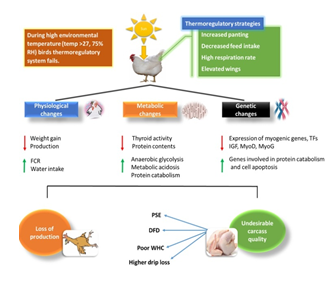
Figure 1: A diagram from Nawaz et al. (2021) illustrating the chain reaction of heat stress. It shows how high temperatures trigger physiological, metabolic, and genetic changes that ultimately result in production losses and undesirable meat quality.
At a cellular level, the damage is even more profound. Heat stress causes a surge in harmful free radicals, leading to oxidative stress that damages muscle cells, impairs protein synthesis, and disrupts energy production. Genetically, the very engines of muscle growth are throttled down. The chicken is, in essence, biologically programmed to stop building muscle in this stressful condition.
A Tale of Two Chickens: The potential of the Dwarf Trait
With the problem clearly defined, in the 2023 study, “Investigating the heat tolerance and production performance in local chicken breed having normal and dwarf size,” a key hypothesis was put to the test: does size matter? The study compared two local Chinese breeds against each other in a controlled heat-stress experiment: The Normal Yellow Chicken (NYC) and the Dwarf Yellow Chicken (DYC).
The results were truly significant and enlightening. When exposed to a week of daily heat at 35°C (95°F), the normal-sized NYC suffered significantly. Its feed intake dropped sharply, and its weight gain and protein efficiency plummeted. Genetically, the NYC’s fat-synthesis genes went into overdrive, while its muscle-growth genes were significantly suppressed.
In stark contrast, the Dwarf Yellow Chicken (DYC) proved remarkably resilient. Its feed intake and growth parameters remained largely stable. Most importantly, its genetic response was somewhat muted; there was no significant activation of fat-synthesizing genes or shutdown of muscle-growth pathways. The dwarf chicken, with its smaller body size and lower metabolic heat production, simply weathered the thermal storm far better.
This study depicted that the production performance and growth rate varied significantly. However, heat treatment in DYC has not shown significant damaging consequences as compared to the control group, which signifies the vital role of the dwarf trait in thermal tolerance. – Nawaz et al., Animal (2023).
Building the Super Chicken: Combining Nature’s Best Traits
Identifying the dwarf trait’s power was a breakthrough, but recent work from the same group, published in 2024, took the next logical step: could combining multiple beneficial traits create an even more robust bird? This study, “Novel insights into heat tolerance: the impact of dwarf and frizzled feather traits on crossbreed chicken performance,” explored the potential of a hybrid chicken created by crossing the Dwarf Yellow Chicken with the Frizzled Feather chicken. The “frizzle” gene is another of nature’s ingenious adaptations.
It causes feathers to curl outwards, disrupting the bird’s insulating layer and allowing for better air circulation over theskin (a form of natural air-conditioning). The hypothesis was that combining the smaller body mass of the dwarf trait with the enhanced heat dissipation of the frizzle trait could produce a uniquely thermotolerant chicken.
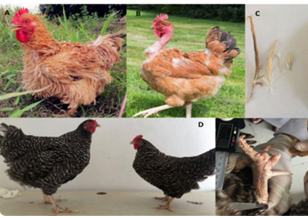
Figure 2: Indigenous chicken breeds possess natural adaptations to heat. This figure from Nawaz et al. (2021) showcases chickens with frizzled feathers (A), a naked neck (B), and a dwarf (D), all traits that enhance heat dissipation are significant in breeding strategy.
After subjecting this new crossbreed to the same heat-stress protocol, the research team made a remarkable discovery. While the birds’ weight gain was still reduced (an expected outcome of heat stress), their overall health and meat quality held up exceptionally well. There were no significant changes in key meat quality indicators like drip loss or cooking loss, and crucially, the birds did not suffer from the systemic inflammation that typically accompanies severe heat stress. Which means, they were up against harshness and coping with extreme temperatures.
The study confirmed that these crossbreed chickens possess an “inherent thermotolerance,” making them a prime candidate for breeding programs in tropical and subtropical regions where heat is a constant challenge.
A Sustainable Future: Looking to the Past
Taken together, this body of work presents a compelling and urgent call for a paradigm shift in the poultry industry. For decades, the focus has been almost exclusively on maximizing growth rate and meat yield. This single-minded selection has created highly efficient but fragile birds, exquisitely adapted to perfect conditions but dangerously vulnerable to the realities of a warming climate. Above mentioned research demonstrates that the path to a sustainable future lies in embracing genetic diversity. The “ancient” genes found in indigenous breeds (like the dwarf, frizzle, and naked neck traits) are not primitive flaws but sophisticated, field-tested solutions to environmental challenges. By reintroducing this genetic resilience into modern commercial lines, it is possible to breed chickens that are not only productive but also robust and fit for the future.
This is not a call to abandon progress, but to redefine it. The goal is no longer just a bigger, faster-growing chicken, but a smarter, more adaptable one. The work of Ali Hassan Nawaz, Li Zhang, and their team provides a scientific roadmap for achieving this, ensuring that the chicken industry can continue to play its vital role in feeding the world, no matter how high the mercury climbs.
This article is inspired by the following research work:
Nawaz, A. H., Jiao, Z., Zhang, L., et al. (2024). Novel insights into heat tolerance: the impact of dwarf and frizzled feather traits on crossbreed chicken performance under thermal stress. Italian Journal of Animal Science, 23(1), 320-330. DOI: 10.1080/1828051X.2024.2314150.
Nawaz, A. H., Lin, S., Wang, F., et al. (2023). Investigating the heat tolerance and production performance in local chicken breed having normal and dwarf size. Animal, 17(3), 100707. DOI: 10.1016/j.animal.2023.100707.
Nawaz, A. H., Amoah, K., Leng, Q. Y., et al. (2021). Poultry Response to Heat Stress: Its Physiological, Metabolic, and Genetic Implications on Meat Production and Quality. Frontiers in Veterinary Science, 8, 699081. DOI: 10.3389/fvets.2021.699081.
About the author
Ali Hassan Nawaz is a PhD research scholar at Nanjing Agricultural University, China, specializing in the genomics of heat tolerance in chickens. Previously, he worked at Guangdong Ocean University, China. He has published several articles as first author in journals including Animal, Poultry Science, Animals, Italian Journal of Animal Science, and Frontiers in Veterinary Medicine. A passionate student of science and philosophy, he embraces new ideas and open discussions. He can be reached at ah93163@gmail.com