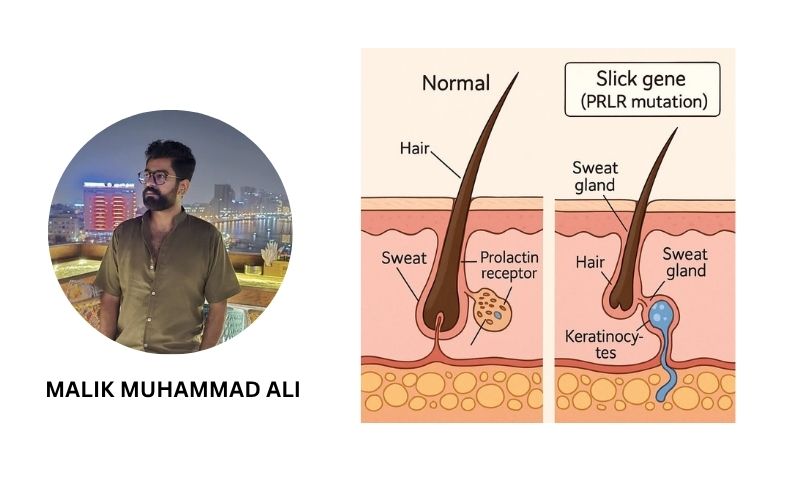
The slick coat (a dominant variant in the prolactin receptor, PRLR) gives cows a naturally shorter, smoother hair coat. In hot, humid weather, it helps them shed heat faster. It’s useful, but it won’t replace good cooling and management.
Thank you for reading this post, don't forget to subscribe!Why people like it:
a. Slick Holsteins tend to show lower core (<0.5 °C) body temperatures and calmer breathing rates during hot spells, with higher sweating capacity. In practical terms, they handle heat waves better than herdmates without slick.
b. When THI is high, slick cows typically lose less milk versus non-slick Holsteins. In cooler months, yields are comparable across groups.
c. Some herds report better summer fertility indicators (e.g., conception rates) when cows stay cooler.
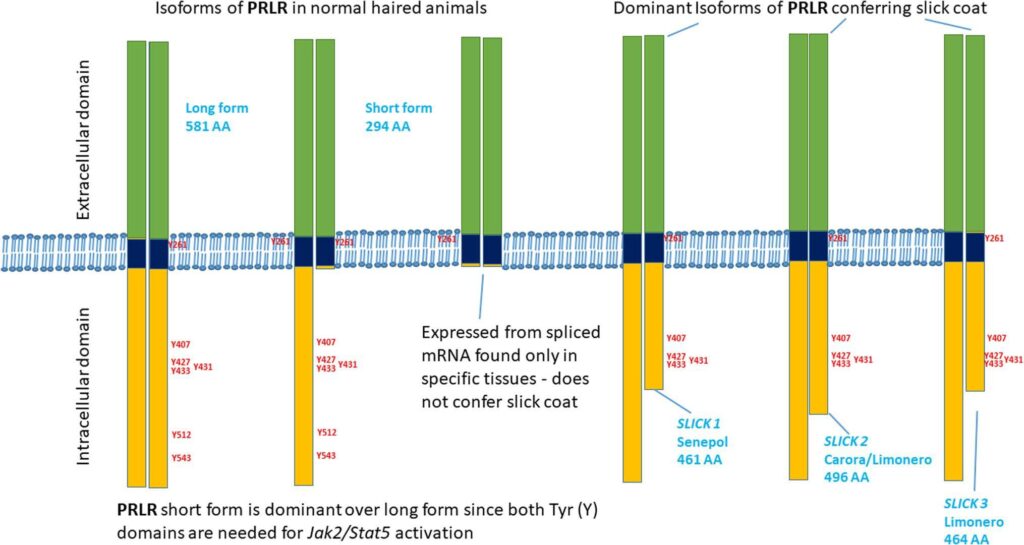
d. The effect traces to PRLR variants seen in several breeds. You can introduce slick via conventional breeding (crossing/backcrossing) or, where regulation allows, via gene-editing programs.
Limitations:
a. Not a silver bullet: Fans, shade, soakers, and ration/electrolyte tweaks still matter. Slick reduces heat load; it doesn’t erase it.
b. Payoff depends on your climate: The advantage shows up most where THI stays high for long stretches. In temperate seasons or cooler regions, the difference may be small.
c. Introgression takes discipline: Bringing slick in from donor breeds and recovering elite Holstein production, type, and health indexes requires several backcross generations with tight genomic selection to avoid dragging along unwanted traits.
d. Regulatory and market optics: If you pursue gene-edited slick, approvals and customer acceptance vary by country; conventional introgression is often easier to deploy today.
e. Youngstock results can vary: Some calf/heifer comparisons show muted differences; management and measurement timing matter.
f. Genetic Limitation: Not a lot of bloodlines with the Slick gene are available, which increases the risk of inbreeding in commercial herds.
How to use it well:
a. Target the problem months: If your site spends a big share of the lactation THI>72, slick can meaningfully buffer performance, especially alongside aggressive cooling.
b. Backcross to elite merit fast: Fix the slick allele while maintaining milk, components, fertility, health, and type via genomic selection; keep an eye on inbreeding.
c. Measure locally: Track vaginal/rectal temp, respiration rate, daily milk by THI, and conception metrics for slick vs. non-slick cohorts. Data will tell you the true ROI.
d. Keep cooling first-class: High-velocity airflow, shade, feed-line soaking, water availability, DCAD/electrolytes, and stocking density still drive most of the outcome.
Summary:
Think of slick as a useful layer of genetic insurance for hot climates. It can trim the summer milk penalty and improve cow comfort, but it pays best when you’re already doing the fundamentals right. I do not see it as a solution to the problem, but a small aid in the process.
Written by Malik Muhammad Ali
International Sales Manager
Alta Genetics
Dairy Consultant
Nishat Dairy Farm