
Munwar Ali
College of Veterinary Medicine, Nanjing Agricultural University, Nanjing 210095, China.
e-mail: drmunwarali06@gmail.com
Background
A new pathogen emerges in a remote community. Within weeks, it circles the globe. This is not a plot from a science fiction film; it is the reality of our interconnected age. It forces a sobering recognition: our health is not an isolated concern. The well-being of humanity is inextricably woven into the health of animals and the vitality of our environment. This holistic understanding is the cornerstone of “One Health”.
Redefining Health for a Connected Planet
One Health is a unified, transdisciplinary strategy that operates from the local to the global level. Its goal is to achieve optimal health outcomes by recognizing the profound interconnection between people, animals, plants, and our shared environment. It is the operationalization of a simple but profound truth: we are one species, living on one planet, within one integrated system.
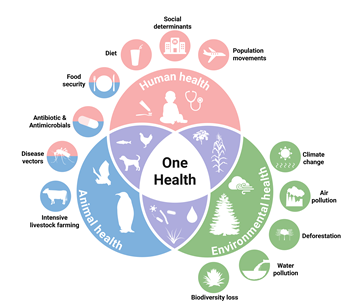
Source: One Health: How to Achieve Optimal Health for People, Animals and Our Planet-Blog. ISGlobal. https://www.isglobal.org/en/healthisglobal/-/custom-blog-portlet/one-health-una-sola-salud-o-como-lograr-a-la-vez-una-salud-optima-para-las-personas-los-animales-y-nuestro-planeta/90586/0
As the figure illustrates, human health is not a solitary peak but the central node in a dynamic network. It is directly and continuously influenced by the health of animals (both livestock and wildlife) and the state of our environment. These connections are not abstract; they are the channels through which diseases spread, food security is determined, and pandemics are born.
The Urgent Case for a Unified Front
The evidence is compelling and alarming. The World Health Organization reports that 60% of known human infectious diseases and up to 75% of new or emerging pathogens are zoonotic; they originate in animals. COVID-19, Ebola, Avian Flu; these are not mere bad luck. They are often the direct result of human pressures on the planet: deforestation, climate change, and intensified livestock farming, which disrupt natural buffers and force dangerous interactions between wildlife, livestock, and people.
One Health is our most powerful framework for moving from reaction to prevention. By breaking down the silos between medicine, veterinary science, and ecology, we can see the whole chessboard, not just the individual pieces.
The Interlinked Challenges We Face
The connections are critical and undeniable:
1. Our Food, Our Health: The journey from farm to fork is a primary pathway for disease. Healthy livestock are the bedrock of both food security and economic stability. A disease in animals is not just an agricultural problem; it is a potential human health crisis. A One Health approach integrates veterinarians into the public health frontline, promoting animal wellness and responsible antibiotic use to safeguard us all.
2. The Borderless Pathogen: Viruses and bacteria do not recognize the boundaries we draw. A pathogen can circulate in a bat population, spill over to a pig, and then jump to a farmer. By monitoring wildlife and ecosystem changes, we can deploy nature’s own early-warning system, transforming surveillance from a reactive cost into a proactive, life-saving investment.
3. Climate Change: The Ultimate Threat Multiplier: A warming world is a sicker world. Rising temperatures are expanding the territories of mosquitoes and ticks, bringing diseases like Dengue and Lyme to new populations. Extreme weather events disrupt habitats, force animal migrations, and compromise water quality, creating new avenues for outbreaks. Climate change stresses every link in the chain of life, making us all more vulnerable.
A Blueprint for a Healthier World
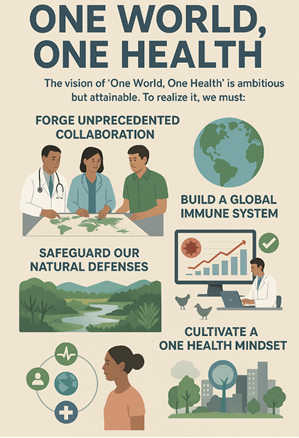
The vision of “One World, One Health” is ambitious but attainable. To realize it, we must:
1. Forge Unprecedented Collaboration: Governments must integrate health, agriculture, and environment ministries, creating joint task forces where doctors, veterinarians, and ecologists design policies together.
2. Build a Global Immune System: We must invest in sophisticated, connected surveillance networks that monitor pathogen activity in animals and environmental changes, giving us the data to predict and prevent pandemics.
3. Safeguard Our Natural Defenses: Protecting forests, wetlands, and biodiversity is not merely conservation; it is a fundamental public health intervention. Intact ecosystems are our best buffer against disease spillover.
4. Cultivate a One Health Mindset: From university curricula to public service announcements, we must instill an understanding of our interconnectedness. From the choices we make as consumers to the policies we support as citizens, everyone has a role.
“One World, One Health” is more than a concept—it is an imperative for the 21st century. Our survival and prosperity are contingent on the vitality of the entire living world. By embracing this interconnected reality, we can forge a future that is not only safer from pandemics but also more resilient and sustainable for all.
Key Resources
For further exploration, these leading global organizations are authoritative sources on the One Health approach:
- World Health Organization (WHO) – One Health: https://www.who.int/health-topics/one-health
2. The One Health Commission: https://www.onehealthcommission.org/
3. Centers for Disease Control and Prevention (CDC) – One Health: https://www.cdc.gov/onehealth/
4. World Organisation for Animal Health (WOAH) – One Health: https://www.woah.org/en/what-we-do/global-initiatives/one-health/
5. United Nations Environment Programme (UNEP) – One Health: https://www.unep.org/explore-topics/chemicals-waste/what-we-do/one-health
6. Wildlife Conservation Society – “One World, One Health”: https://oneworldonehealth.wcs.org/
Author biography
Munwar Ali
M.Phil. (Veterinary Parasitology)
College of Veterinary Medicine,
Nanjing Agricultural University, China.
Munwar Ali, a Doctor of Veterinary Medicine (DVM), is a dedicated postgraduate researcher at Nanjing Agricultural University, China, specializing in veterinary medicine and parasitology through a One Health lens. He has received the prestigious Jiangsu Provincial Scholarship for 2024, in recognition of his outstanding performance. Munwar Ali has published over 20 papers in esteemed journals, including the Journal of Integrative Agriculture, Veterinary Parasitology, Ecotoxicity and Environmental Safety, International Journal of Biological Macromolecules, Animals, etc., with several as the first author. His research interests encompass anti-Cryptosporidium drug discovery, gut microbiota, enteric immunity, and host-parasite interactions.