By Dr. Syeda Refat Sultana
Department of Soil & Environmental Sciences, Ghazi University
Climate change is no longer a distant concern it has become a daily reality that is reshaping economies, ecosystems, and communities across the world. From recordbreaking heatwaves and erratic monsoon patterns to widespread flooding and crop losses, the effects are now impossible to ignore. As these pressures intensify, climate policies focused on mitigation and adaptation have become essential tools for
protecting vulnerable populations.
Mitigation efforts such as transitioning to renewable energy, enhancing energy
efficiency, and conserving natural landscapes seek to reduce the drivers of climate change. Adaptation strategies, meanwhile, address its inevitable impacts through measures like flood-defence systems, drought-resistant crops, water-management reforms, and early-warning mechanisms.
Global Lessons in Resilience
Several countries offer powerful examples of how climate policy translates into real resilience on the ground.
Bangladesh has constructed more than 2,500 cyclone shelters in high-risk coastal areas, which have saved thousands of lives during severe storms. Farmers are increasingly adopting salt-tolerant rice varieties to cope with the rising salinity of agricultural land.
Pakistan’s Green Pakistan Programme with its large-scale tree plantation efforts has restored damaged landscapes, boosted biodiversity, and created green employment. Nepal’s Local Adaptation Plans of Action (LAPAs) demonstrate how involving communities in decision-making leads to effective local solutions, including river embankments and community-driven flood forecasting. Kenya is directing climate finance toward renewable energy and climate-smart agriculture, strengthening rural
livelihoods.
The Economics of Climate Action
The economic rationale for climate resilience is equally clear. According to the OECD, climate-related damages have more than doubled over the past two decades, costing an estimated $200 billion annually since 2015. Investing in adaptation significantly reduces these losses while creating new economic opportunities. Renewable energy, sustainable construction, and water-efficient technologies are now multi-billion-dollar global industries generating millions of jobs.
Challenges That Persist
Despite progress, several barriers continue to impede implementation: insufficient financing, weak governance systems, low public awareness, and limited access to accurate climate data. These gaps often delay or weaken the impact of climate interventions.
To build lasting resilience, governments must prioritise climate funding, strengthen institutional capacity, and improve coordination between national, provincial, and community actors. Without this alignment, even well-designed policies struggle to deliver real results.
The Importance of Community Participation
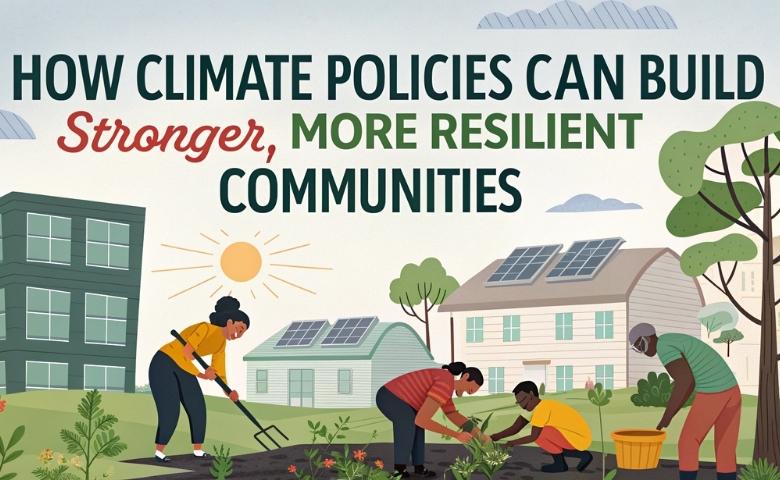
One of the clearest lessons from global examples is the importance of community-led action. Indonesia’s “Kampung Iklim” (Climate Village) programme shows how empowering people at the grassroots leads to long-lasting climate solutions such as restored green spaces, improved waste management, and better disaster preparedness.
A Path Forward
As climate threats continue to escalate, mitigation and adaptation must advance simultaneously. With sustained investment, community engagement, and strong political will, climate policies can help societies not only withstand the shocks of a changing climate but emerge safer, stronger, and more resilient.
For Pakistan, strengthening climate governance, scaling local adaptation efforts, and
integrating scientific research into policymaking will be crucial steps in building a
climate-secure future.