As the world confronts escalating climate challenges, artificial intelligence is emerging as both a potential solution and a growing environmental concern.
Thank you for reading this post, don't forget to subscribe!Artificial intelligence was once widely promoted as a transformative tool capable of helping humanity tackle climate change. Through innovations such as predictive forecasting, satellite monitoring, smart energy grids, and early warning systems, AI promised to support global sustainability efforts. However, mounting evidence now suggests that the technology itself may be contributing to environmental strain due to its enormous energy, water, and computational demands.
The Promise of AI for Climate Solutions
Some global institutions and technology leaders continue to emphasize AI’s potential environmental benefits. UN climate chief Simon Stiell has stated that artificial intelligence could help reduce global heating by improving industrial efficiency and lowering carbon emissions through advanced optimization tools.
Major tech firms have also made ambitious projections. In a 2023 blog post, Google claimed that large-scale adoption of AI could reduce global greenhouse gas emissions by 5–10 percent by 2030. Similarly, the International Energy Agency (IEA) suggested that AI applications might cut global emissions by up to 5 percent by 2035.
Such statements have fueled optimism among communities already suffering the consequences of climate change, raising hopes that technological innovation could accelerate climate mitigation.
New Report Challenges “Green AI” Narrative
A recent report commissioned by several non-profit organizations, including Climate Action Against Disinformation, casts doubt on these optimistic claims. The report describes many corporate sustainability promises as an “AI climate hoax,” arguing that there is little verifiable evidence demonstrating that current generative AI systems significantly reduce emissions.
Researchers found no substantial, measurable example where widely used tools such as Google’s Gemini or Microsoft’s Copilot produced meaningful reductions in planet-warming emissions.
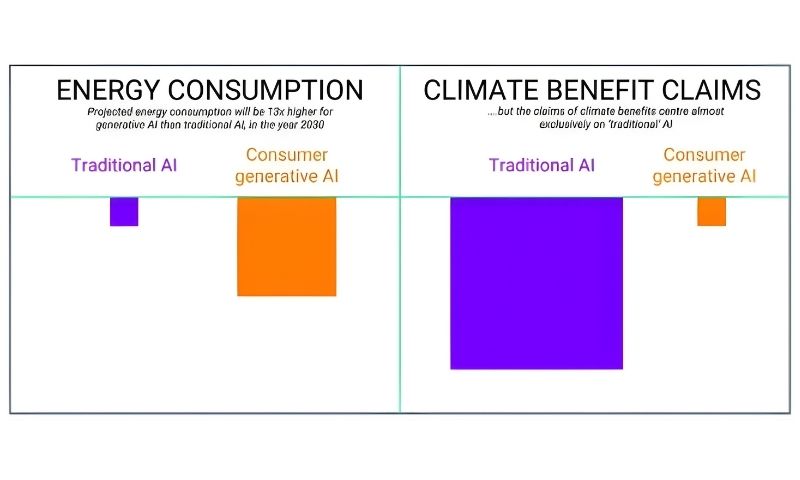
Evidence Gap in Corporate Claims
An analysis of 154 climate-related statements made by major technology companies and organizations revealed concerning gaps:
- 36% cited no evidence at all
- Only 26% were supported by published academic research
This suggests that many environmental claims about AI rely more on projections or assumptions than on verified scientific outcomes.
Concerns About “AI Greenwashing”
The report also accuses parts of the technology sector of engaging in greenwashing — presenting environmentally friendly narratives to justify the expansion of energy-intensive AI infrastructure.
Experts argue that companies often blur the distinction between traditional machine-learning systems (which can improve efficiency) and modern generative AI, which requires vastly greater computing power and data center resources.
Environmental Cost of Generative AI
Generative AI models rely on massive data centers that consume significant amounts of electricity and water for processing and cooling. According to a study published in the journal Patterns, data centers alone may have emitted between:
32.6 million and 79.7 million tonnes of CO₂ in 2025
— roughly equivalent to the annual emissions of a small European country.
Sasha Luccioni, AI and climate lead at the open-source platform Hugging Face, explains:
A Technology at a Crossroads
Artificial intelligence remains a powerful tool with the potential to support climate science, energy optimization, and environmental monitoring. Yet its rapidly expanding infrastructure raises urgent questions about sustainability, transparency, and accountability.
The debate highlights a central dilemma: Can AI truly help solve climate change if its own growth accelerates emissions?
As governments, researchers, and industry leaders continue to evaluate AI’s environmental footprint, experts emphasize the need for independent verification of climate claims, improved efficiency standards, and responsible innovation.